
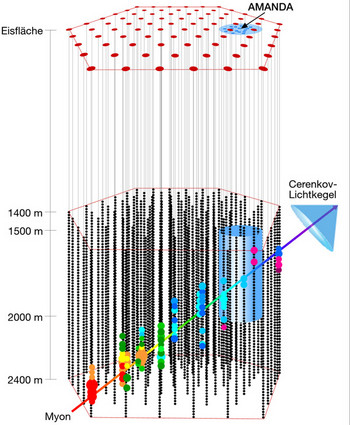
- The muon is generated via the collision of a neutrino with an atom. What you can see is the detection via the photo-detectors of the light produced by the muon.
IceCube - A new window to the Universe
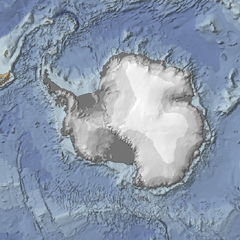
The Antartic plateau is a unique astrophysical observatory. The dry, cold atmosphere provides unprecedented observation conditions for radio astronomers. The Amundsen-Scott Station at the geographical South Pole hosts several radio telescopes which are devoted to the study of the 3K microwave background radiation, a relic from the Big bang. Other telescopes are tailored for the detection of sub-millimeter waves and infrared radiation.
However, the most spectacular instrument at the station is IceCube, a detector searching for energetic neutrinos from cosmic sources. Neutrinos are electrically neutral elementary particles which extremely rarely interact with matter. That is why they can escape cosmic regions which are hidden with respect to light, and can provide unique information from the environment of black holes or from the interior of stars. The rareness of the interactions requires huge detection volumes in order to catch some of the few reactions. IceCube is going to consist of an array of highly sensitive photodetectors which are frozen into the 3 km thick ice layer covering the South Pole. These photosensors record the tiny light flashes generated by neutrino interactions. Clamped to cable strings, they are deployed into holes which have been melted with hot water. IceCube will consist of 4800 of such sensors, distributed across a cubic kilometre of ice. It will be 30 times larger than AMANDA, its predecessor telescope at the same place which takes data since 2000. Until now, 1400 sensors have been installed, construction will be completed in 2011.
Why the South Pole? Firstly, the deep ice is very transparent, an important condition to detect the faint flashes. Secondly, the ice is so thick that sensors can be deployed at a depth where they are well shielded against noise radiation from other sources. And finally, the Amundsen-Scott station provides an excellent infrastructure.
IceCube is basically an US-European project, with the US National Science Foundation NSF being the lead funding institution. German institutions include DESY/Zeuthen and universities in Aachen, Berlin, Dortmund, Mainz and Wuppertal. DESY contributes 1300 of the total of 4800 sensors.
Scientists expect to get answers to questions like that about the origin of cosmic rays, about the nature of dark matter or about the existence of exotic particles like magnetic monopoles. Often, opening a new observation window has resulted in discoveries which before had not been on the buying list of scientists. This is also what IceCube physicists hope for. Beyond studying astrophysical phenomena, IceCube is also used to provide information about Antarctic climate over the last hundred thousands of years, based on the optical properties of the ice.